He will use the award to explore creative new approaches to his work in complex differential geometry
Tamás Darvas, an assistant professor of mathematics at the University of Maryland, has been awarded a 2021 Sloan Research Fellowship. Granted by the Alfred P. Sloan Foundation, this award identifies 128 early-career scientists based on their potential to contribute fundamentally significant research to a wider academic community.
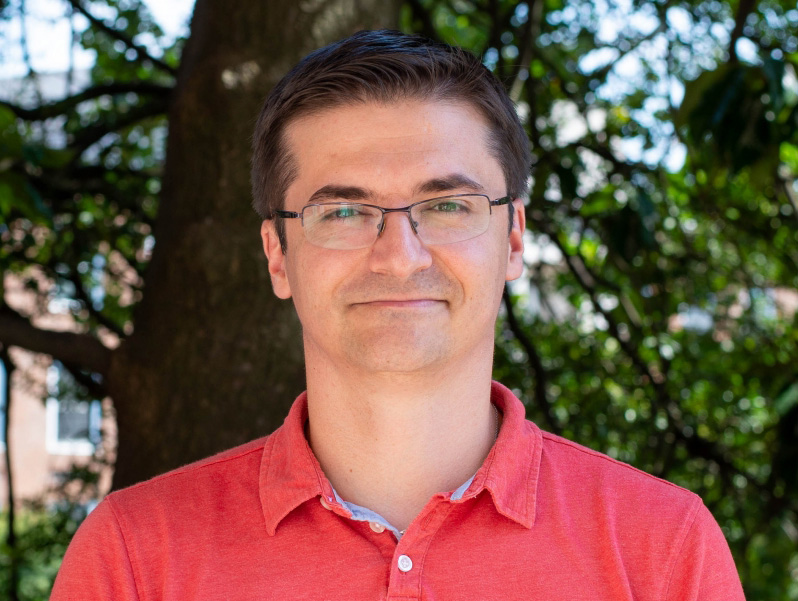 Tamás Darvas. Photo courtesy of same.
Darvas, whose research focuses on complex differential geometry, will use the $75,000 unrestricted award to explore areas of research that are less likely to be funded by traditional sources.
“Every mathematician tends to have ideas sitting around for years that they just can’t get to because they’re more high-risk, high-reward and harder to fund,” Darvas said. “I hope to use this award to push my research further in directions that are adventurous and creative and explore pathways that I wouldn’t normally be able to do. I am very grateful to the Sloan committee for recognizing my work in this way. It is not something I take for granted.”
Darvas’ eagerness to think creatively and outside the box is exactly what propelled UMD Department of Mathematics Chair Doron Levy to nominate Darvas for this fellowship. Candidates must be nominated by their fellow scientists. Recipients are selected by independent panels of senior scholars on the basis of their research accomplishments, creativity and potential to become a leader in their field.
“Dr. Tamás Darvas is a young geometer of exceptional ability, already with a highly distinguished record of achievement,” Levy said. “He does not follow in the footsteps of others, but boldly charts new territories that lead to paradigm shifts, and he is already a leader in his field.”
Darvas studies canonical metrics in Kähler geometry. In its simplest form, a canonical metric explores the best way to measure distances on unevenly curved surfaces. It’s a little like measuring distances across a beanbag or potato versus the straightforward calculations of measuring distances across a sphere. Canonical metrics have connections with infinite dimensional spaces, with applications in fields ranging from fluid dynamics to quantum mechanics.
Darvas’ work pushes the boundaries of scientific understanding at the intersection between algebraic geometry, differential geometry and complex analysis. His results increase mathematical understanding of all of these subjects and their relationship to one another, and they may help physicists improve their perception of the universe.
For example, in 2019, Darvas’ research revealed that the fundamental connection between constant curvature and the existence of symmetries is much more intricate than mathematicians expected. In three-dimensional space, most basic shapes, such as spheres and cylinders, have constant curvature and many symmetries: spheres stay the same under any rotation and cylinders don’t change if a rotation is applied to the central axis. Darvas showed that the infinite dimensional space of Kähler metrics has almost no symmetries, despite having constant curvature.
The author of 24 peer-reviewed journal articles, Darvas received a Faculty Early Career Development (CAREER) award from the National Science Foundation in 2019. He joined UMD in 2014 as a postdoctoral fellow and became an assistant professor in 2018. Darvas earned his Ph.D. in mathematics at Purdue University in 2014 and his bachelor’s and master’s degrees in mathematics from Babeș-Bolyai University in Romania in 2008 and 2009, respectively.
Darvas joins the list of 40 current UMD College of Computer, Mathematical, and Natural Sciences faculty members who have received Sloan Research Fellowships. The two-year Sloan Research Fellowships are awarded to U.S. and Canadian researchers in the fields of chemistry, computational and evolutionary molecular biology, computer science, Earth system science, economics, mathematics, neuroscience and physics.
“A Sloan Research Fellow is a rising star, plain and simple,” said Adam F. Falk, president of the Alfred P. Sloan Foundation. “To receive a Fellowship is to be told by the scientific community that your achievements as a young scholar are already driving the research frontier.”
Article was copied from https://cmns.umd.edu/news-events/features/4730


