
He is the first member of UMD’s Department of Mathematics to receive this prestigious award for young mathematicians.
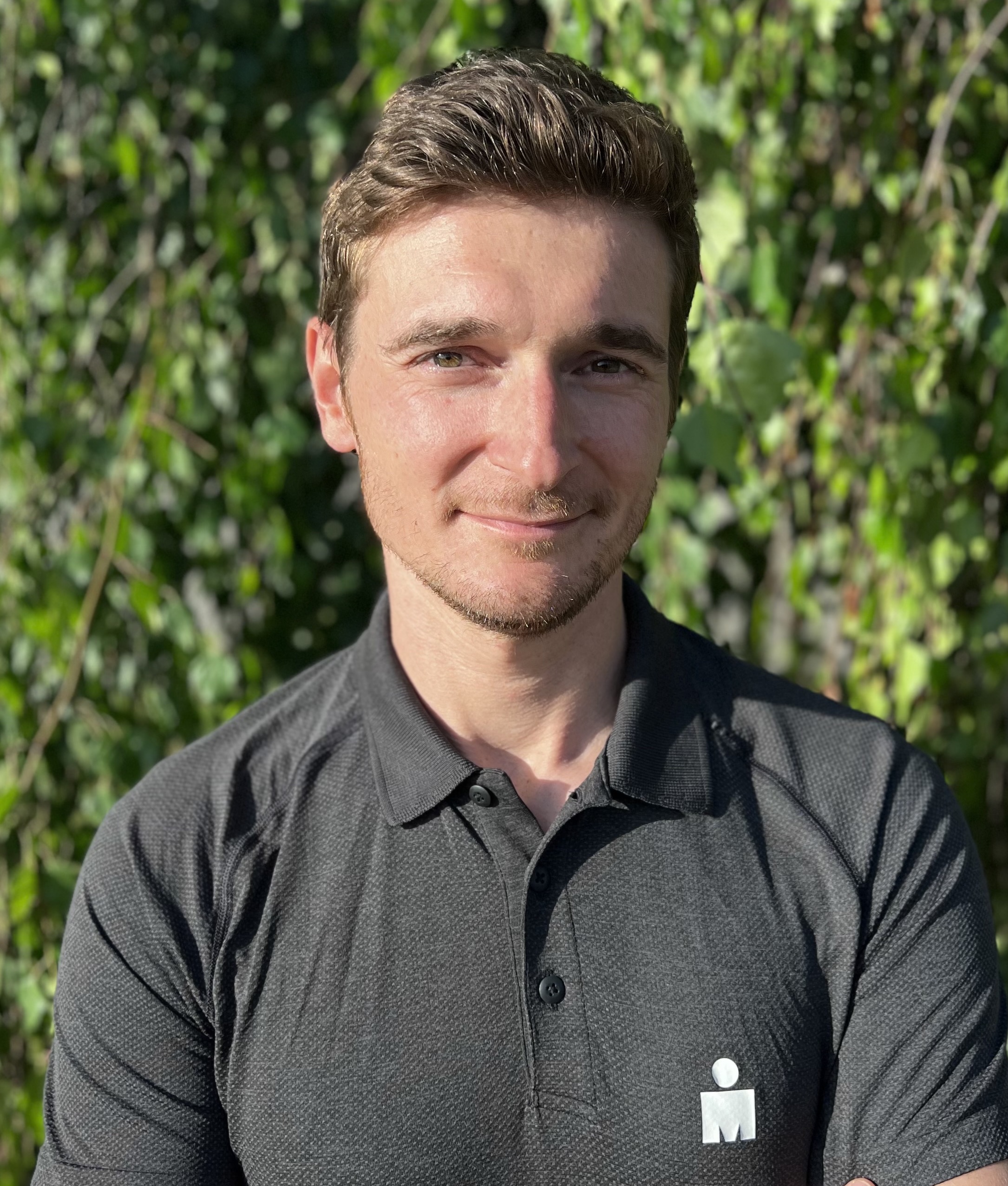 The European Mathematical Society (EMS) awarded a 2024 EMS Prize to Adam Kanigowski, a Polish-born associate professor in the University of Maryland’s Department of Mathematics. Established in 1992, the prize is presented every four years to esteemed mathematicians aged 35 or under who work in Europe or are of European nationality.
Kanigowski will accept his award on July 15, 2024, at the 9th European Congress of Mathematics in Seville, Spain, where he will also present his research on slow chaos, a subset of chaos theory that involves studying unpredictable events that unfold gradually.
When he first learned he received this award, Kanigowski said he was pleased and humbled by the honor.
“It’s quite a prestigious award, and I’m happy that the work I’ve put in was noticed by other people,” he said.
No more than 10 people receive an EMS Prize in each award cycle, and Kanigowski’s achievement represents a first for UMD.
"We have never had a member of our department receive this award,” said Mathematics Chair Doron Levy. “This is a huge recognition, and many of the previous winners have gone on to receive the Fields Medal."
Kanigowski is a theorist specializing in dynamical systems, a mathematical tool for understanding changes in complex systems over time. He earned his master’s degree from the Nicolaus Copernicus University in Toruń, Poland, in 2012 and his Ph.D. from the Institute of Mathematics of the Polish Academy of Sciences in Warsaw in 2015.
After graduating, he joined Penn State University as an S. Chowla Research Assistant Professor in 2015 and then joined UMD as an assistant professor in 2018 after learning more about its dynamics group.
“I think that the dynamics group at UMD is one of the strongest in the U.S., so it was a natural decision for me,” he said. “I'm happy that I can be a part of it.”
Kanigowski’s background is uniquely suited to one of his current responsibilities at UMD: helping to strengthen the relationship between the dynamics groups at UMD and Penn State. Each year since 1991, the two universities jointly sponsored conferences on dynamical systems on their respective campuses. Kanigowski led the organization of UMD’s conference this year, which brought together more than a dozen speakers from around the world in April.
Over the last six years, Kanigowski said he has learned a great deal from his colleagues in the dynamics group—especially Distinguished University Professor Dmitry Dolgopyat—and benefited from his collaborations with Professors Bassam Fayad and Giovanni Forni. Kanigowski has published more than 40 papers in premier mathematical journals—including the Journal of the American Mathematical Society, Annals of Mathematics and Inventiones Mathematicae—and contributed new understandings of the Ratner property, a mathematical concept developed in the 1980s.
In addition to the 2024 EMS Prize, Kanigowski received two other professional awards this year. In March, the Simons Foundation named him a 2024 Simons Fellow in Mathematics, and in April he received the Award of the Institute of Mathematics of the Polish Academy of Sciences for his contributions to the fields of dynamical systems and ergodic theory.
Since December 2022, Kanigowski has led a flagship project at Jagiellonian University in Poland that partly supports a research collaboration with UMD. He also enjoys spending time with his daughters and competing in triathlons. He finished his first Ironman triathlon in Austria in June—a feat wholly separate from his math interests, but one he worked just as hard for.
“I think the stereotype for a mathematician is a person who sits at their desk and is not very active in sports, so finishing a triathlon is one thing I’m really proud of,” he said.
So far this summer, Kanigowski has not stayed idle for long. He recently gave a talk in Bologna, Italy, at a birthday celebration for Forni, an alum of the University of Bologna. He then traveled to Singapore to work with a colleague before boarding a flight to Seville for this week's European Congress of Mathematics.
“There will be a variety of talks at the congress,” he said, “so I'm excited to see the new trends and latest developments in math.”

Sandeep Ramesh (B.S. ’22 mathematics; B.S. ’22 computer science) spins a fantasy sports internship into a full-time job at DraftKings
 Sandeep Ramesh (B.S. ’22, mathematics; B.S. ’22, computer science) has gone all-in on three things he’s passionate about: mathematics, computers and sports. But he never imagined he would find a career that combined those things until the summer before his senior year at the University of Maryland, when he landed a summer internship at DraftKings, a Boston-based daily fantasy and sports betting operator.
“I don’t think a company like DraftKings was even on my radar if you’d asked me as a freshman or sophomore,” Ramesh said. “The career path in my head was always to go to Big Tech, you know Microsoft or Google, something like that. But I got lucky and found something different that’s a great fit for me.”
Thanks to his summer internship, Ramesh scored a full-time data science engineer job at DraftKings after graduation, and he’s already making his mark.
“Even though I’ve only been here a year, I feel like I’m already making an impact,” Ramesh said. “Because of the internship experience, I feel like I was able to transition quickly and hit the ground running.”
Learning to love math (and soccer)
For Ramesh, math and sports have always been part of life. Encouraged by his dad, he started playing soccer—and doing complex math problems—almost before he started school.
“My dad wanted to get me exposed to as many different sports as possible, so I did a year or two of baseball—I was terrible—, a few years of basketball, and I’ve been playing soccer practically since I could walk and I still play today,” Ramesh said. “As for math, my dad definitely pushed me early on. He’d give me five or 10 problems with six-digit numbers and he’d say “Multiply these,” or “Try and divide these,” and I think that sparked an early affinity for math and numbers.”
When Ramesh got to high school, he took advanced placement math and science classes and explored a growing interest in computers and engineering. In 2019 when he started his undergraduate work at UMD he set his sights on computer science, but math was never far from his mind.
“Freshman year, I took linear algebra with Nathan Manning and it became one of my favorite subjects,” Ramesh recalled. “Initially I was going to do pure software engineering, but after I started to enjoy the math side of things and proof-based mathematics I started wanting a more math-heavy type of career, so the big thing I was trying to get into initially was quantitative finance.”
In his spare time, he dabbled in trading strategies with Apex Fund, a student-run investment program.
“They were looking to set up a quantitative side of the program, so they brought in me and another student—funny that we all met in that Nathan Manning algebra class—and it was a ton of fun,” Ramesh said. “We would act like normal hedge funds do nowadays, looking at stocks and analyzing them to try and predict create and backtest certain strategies.”
Through his experiences at UMD, Ramesh began to see how a math and computer science skill set could open up big real-world career opportunities in finance, big tech and beyond.
“That’s what I liked—you had so many options,” he explained. “You could go super math-heavy and go into finance, but you could also merge math with some computer science and be a data scientist or a data science engineer.”
From investment analytics to fantasy sports
Two summer internships with an investment firm gave Ramesh valuable experience in software engineering and investment analytics.
“In the first internship I was doing more application development, which wasn’t the most entertaining as it was mainly code testing” Ramesh said. “Then the next summer I wanted to do more investment-focused work, and that allowed me to use a lot more math skills and modeling.”
At the end of his junior year, Ramesh decided he was ready to take his data science skills in a very different direction. Encouraged by a friend in his fraternity, Ramesh landed a summer internship at DraftKings, where he contributed to the company’s entertainment products and gaming experiences for fantasy sports and betting.
“My project that summer was related to daily fantasy sports,” he explained. “You have a basic amount of money, like $50,000, you have to draft six or seven players, and my project was to figure out what the salaries for those players should be, specifically for college football. I really enjoyed it.”
It was definitely a detour from the Big Tech career path he had in mind a few years earlier, but for Ramesh, the collaborative culture at DraftKings felt welcoming and supportive. And shifting to sports data gave him a whole new perspective.
“I think the biggest thing was that I was able to comprehend the data a lot better,” he said. “In investments when I’d see a stock name or a ticker name I’d recognize the company, but I didn’t really know what all the numbers meant. But seeing a college football quarterback at Alabama, I can see their passing and rushing yards and I can actually comprehend each of these data points and their relationships with a lot more understanding.”
Realizing he’d found his niche, Ramesh worked hard during his internship to make a memorable impact. And it paid off. By the time Ramesh started his senior year, DraftKings offered him a full-time position as a data science engineer.
“It’s honestly the dream scenario,” he said. “I think this role specifically is the perfect combination of my degrees—computer science on one side and mathematics and statistics on the other—and I think having both degrees has enabled me to be impactful on both sides of things here.”
After more than a year working on everything from fantasy sports to fraud prevention, Ramesh feels energized by the work and the company’s unique environment.
“We have TVs everywhere so whatever’s going on, whether it’s MLB or soccer, you can just glance up and catch the game, and each area of the office is actually themed after a specific sport,” Ramesh explained. “Right now I’m in the (Derek) Jeter conference room and I’m a big soccer fan so I used to take meetings from the Pelé conference room. Things like that make it a lot more entertaining.”
It's a long way from the path Ramesh thought he’d take in data science—but for him, it couldn’t be better.
“This experience changed how I look at my future—I’ve learned to never turn down an opportunity just because it’s the path less traveled. I think not ending up at Big Tech ended up being a blessing for me,” Ramesh reflected. There are so many opportunities here at DraftKings that I would not normally have if I had gone to Big Tech or any other more traditional firm. I’ve learned that while this route may be unorthodox, it’s truly the best fit for me. I would say my career is off to a great start.”
Written by Leslie Miller

Abba Gumel uses mathematical models to understand how diseases spread—and how to stop them.
- Mathematics Faculty Awarded 2024 Teaching Innovation Grants
- Jacqueline Dwyer-Xec and Archana Khurana Receive Do Good Innovator Awards
- Maria Cameron Receives 2024 MURI Award
- Kayo Ide Joins Consortium to Improve Accuracy of Weather Forecasts
- Department Receives $27.2 Million Gift to Support Mathematics Research and Outreach

New Study Charts Paths to End Cervical Cancer

UMD’s Math-Musician Chases His Next ‘Beautiful Idea’

Finding Infinity in Planetary Motion
4176 Campus Drive
William E. Kirwan Hall
College Park, MD 20742-4015
P: 301.405.5047 | F: 301.314.0827
Give to the Math Department