
As Professor of Mathematics Dan Cristofaro-Gardiner prepares for one of his field’s biggest stages this summer, his recent string of honors reflects a career built on curiosity, collaboration and surprising connections.
—
This summer, mathematicians from around the world will gather in Philadelphia for the International Congress of Mathematicians (ICM)—the largest and most prestigious conference on mathematics in the world. Meeting only once every four years, the ICM is often called the Olympics equivalent in the field of mathematics because it recognizes the most influential figures in the discipline.
In July, University of Maryland Professor of Mathematics Dan Cristofaro-Gardiner will take the stage as one of only a few handful of invited speakers, a distinction that puts him among a select group. For any mathematician, it’s a career-defining moment—but for Cristofaro-Gardiner, this opportunity marks another milestone in an extraordinary run.
In 2025, Cristofaro-Gardiner won the prestigious Michael Brin Prize in Dynamical Systems, an international award for outstanding contributions by early-career mathematicians. He also delivered the historic Marston Morse Lectures at the Institute for Advanced Study, a series of talks celebrating the 100th anniversary of groundbreaking work that helped shape modern mathematics.
For Cristofaro-Gardiner, this latest invitation to present at the ICM is even more meaningful because he won’t be the only Terp there; three other UMD mathematicians—Uri Bader, Dmitry Dolgopyat and Adam Kanigowski—were invited to present as well.
“Four of us will speak, which definitely puts UMD among the most in the world,” he said, noting that UMD’s representation at the event reflects the university’s considerable strength in the field. “I feel extremely excited and honored to be recognized alongside them.”
Unseen connections that changed everything
Ask Cristofaro-Gardiner how he arrived at this moment, and he’ll refer to his days as a Ph.D. student at the University of California, Berkeley. While searching for a research direction, he encountered a paper that seemed extremely surprising.
Mathematician Clifford Taubes had taken ideas from string theory and mathematical physics—fields that appeared to have nothing to do with planetary motion—and used them to solve a decades-old problem about periodic orbits, in a field going back centuries.
“Think of the solar system,” Cristofaro-Gardiner explained. “Planets move, interact through gravity, cycle through space. The question is whether there are configurations where the entire system returns to exactly the same state.”
Taubes found a cosmic reset button by using these unrelated tools, a discovery that inspired Cristofaro-Gardiner’s own research. His goal was to see if it was possible to find other kinds of periodic orbits.
The answer, it turned out, was yes—and then some. Using techniques from what’s called low-dimensional topology, Cristofaro-Gardiner and his collaborators showed that certain systems don’t just have a few periodic orbits, but a large number of them. His results revealed abundance where other mathematicians had searched without much success, leading to one of several breakthroughs recognized by the Brin Prize.
Cristofaro-Gardiner’s celebrated paper on the Simplicity Conjecture, published in the Annals of Mathematics with collaborators Vincent Humilière and Sobhan Seyfaddini, earned a Bourbaki seminar—one of the highest honors in mathematics—and was featured in a National Science Foundation article as solving “one of the mysteries of two-dimensional shapes.” Among the five papers by Cristofaro-Gardiner that were cited for the Brin prize, two focus on symmetries of the sphere and recovering volumes from periodic orbits, both showcasing his ability to bridge seemingly distant mathematical worlds.
Cristofaro-Gardiner is especially drawn to such surprises in math.
“For example, take four-dimensional space,” he said. “You might assume that as dimensions increase, things simply get more complicated; that four dimensions is harder than three, seven is harder than four and so on.”
But the truth is stranger, Cristofaro-Gardiner noted. In every dimension except the fourth, there’s fundamentally only one way to do calculus in standard space.
“Only in dimension four do you have infinitely many different ways of doing calculus,” he said. “Four dimensions is special, strange, uniquely rich. And it comes with another surprise: this fact actually connects directly to planetary motion and the kind of periodic orbits I study.”
For Cristofaro-Gardiner, these unexpected connections made his participation in the Marston Morse Lectures particularly meaningful to him. Morse was one of the first to theorize that there could be interesting relationships between geometry and dynamics.
“His work asked if you could deduce what shape you’re living on simply by studying functions defined on it. Can you tell you’re on a sphere just by measuring latitude, temperature or some other property at every point?” Cristofaro-Gardiner explained. “That’s also a fundamental theme in my own work and his ideas continue to generate new ones.”
Building a community
Since joining UMD in 2021 from the University of California, Santa Cruz, Cristofaro-Gardiner has built his work around collaboration, supervising three Ph.D. students, teaching reading courses with two others and co-organizing events like the Informal Geometric Analysis seminar.
“Research is interesting, particularly groundbreaking research, because you really have to push on the frontiers of human knowledge,” he reflected. “If I’m just sitting at my desk working alone—and of course, sometimes that is just what’s needed—my thinking can be isolated in my mind, like in a completely closed system. You never know which stray comment or unfamiliar technique can unlock your next breakthrough.”
Cristofaro-Gardiner believes that seminars, collaborations and even casual hallway conversations contribute to “a very rich intellectual environment.” He attends and helps organize multiple meetings across geometry and dynamics at UMD, welcoming new ideas that might not have entered his consciousness otherwise.
For students, these events serve another purpose: bridging the gap between settled knowledge and active research.
“Usually, what you will learn in a course is settled science,” he pointed out. “I’m teaching algebraic topology that was worked out 50 years ago, stuff that’s important and foundational but not what we’re grappling with today. Seminars can let students really learn what we’re doing in the field right now, putting faces to names, discovering which problems remain unsolved.”
As Cristofaro-Gardiner prepares for his talk in Philadelphia, he remains focused on his dual mission: advancing human knowledge and giving the next generation of mathematicians the resources they need to succeed.
“It’s wonderful to see UMD, a public university, so strong in my field,” he said. “I’d love to just do my part to make sure that our students have access to a world-class mathematical experience.”
Written by Georgia Jiang

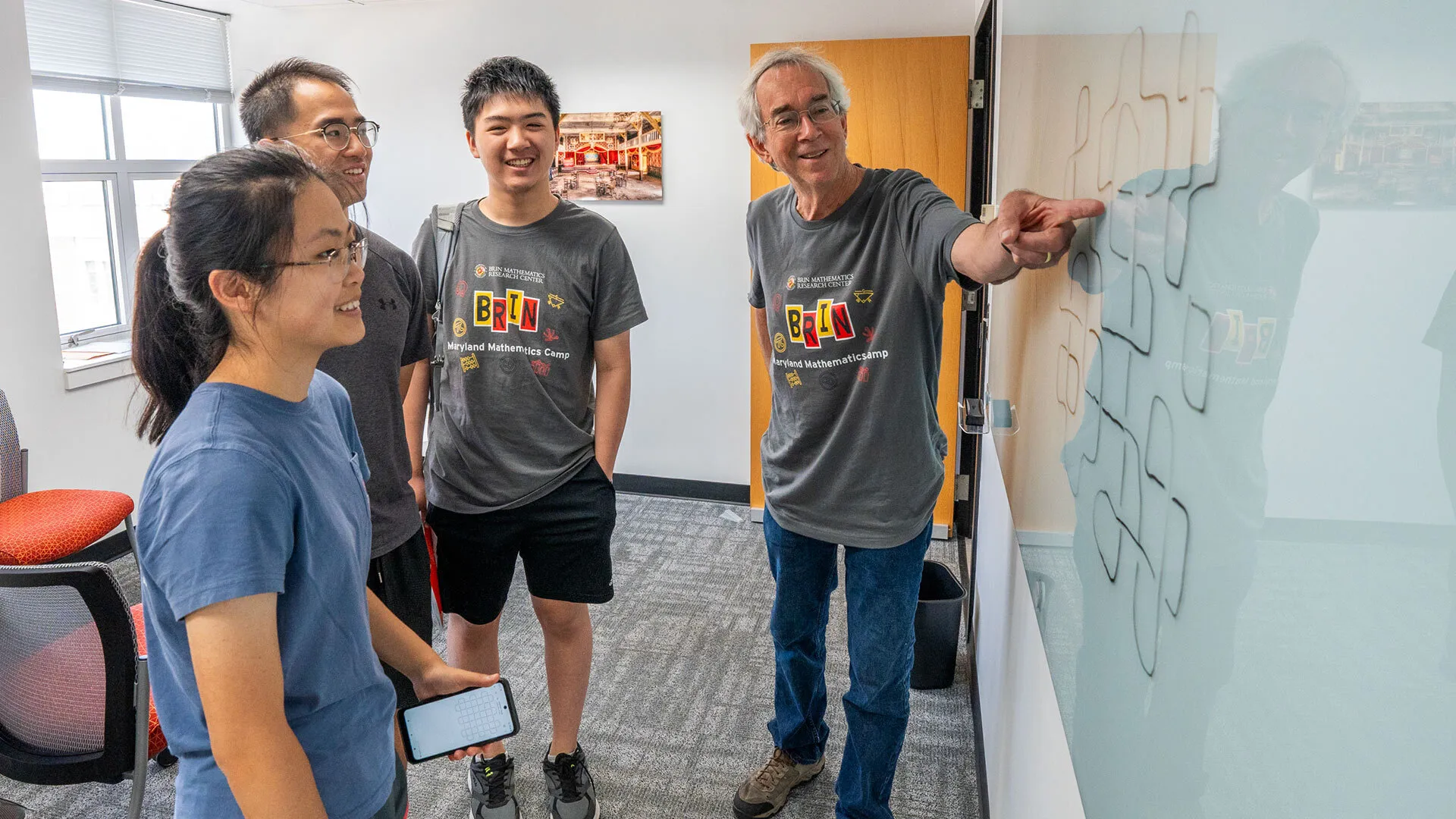
Professor Larry Washington, associate chair for undergraduate education in UMD's math department, works with students attending the first year of the Brin Maryland Mathematics Camp in 2024. The camp for exceptional high school math students was funded by a $27.2 million gift from Michael and Eugenia Brin. (Credit: Mark Sherwood)
The year after a new mathematics research center sprang up on the University of Maryland campus, the math department chair flew to California to talk to the couple who’d made it possible, Professor Emeritus Michael Brin and his wife, Eugenia.
Chair Doron Levy laid out all that he and colleagues raced to accomplish since the $4.75 million gift was announced in 2021—hosting international conferences, supporting research, renovating office space, hiring staff and conducting layers of strategic planning. Pleased by their progress, Michael Brin looked up and joked, “I don’t remember giving you so much money.”
It was the best endorsement the math chair could have hoped for regarding the Brin Mathematics Research Center. Before long, the Brins would give much more, donating an additional $27.2 million to endow the center, which has blossomed into a leading global crossroads for math research; UMD has climbed the U.S. News & World Report rankings to become the nation’s No. 6 graduate-level math program among public universities.
Of that total amount, $2 million created two endowed professorships in the department, while $200,000 funded the piloting of a summer math camp for exceptionally talented youths.
That March 2024 gift is included in Forward: The University of Maryland Campaign for the Fearless, a campuswide effort to raise $2.5 billion that officially kicked off this week. The Brins and the Sergey Brin Family Foundation, established by the couple’s older son, Sergey, a Google co-founder and 1993 UMD graduate, have given approximately $57 million to UMD.
“This latest gift from the remarkable Brin family has been truly transformative and a testament to the power of philanthropy in shaping academic excellence,” said Amitabh Varshney, dean of the College of Computer, Mathematical, and Natural Sciences and professor of computer science. “Thanks to their generosity, we have welcomed hundreds of scholars and students into our vibrant mathematics community through Brin Mathematics Research Center workshops and the Brin Maryland Mathematics Camp.”
Beyond the physical space in the Computer Science Instructional Center, one of the most visible results of the Brins’ philanthropy is the steady drumbeat of workshops, summer schools and distinguished lectures. The events are central to the Brin Center’s operations because academic mathematics, despite what the uninitiated might envision, is an intensely social discipline.
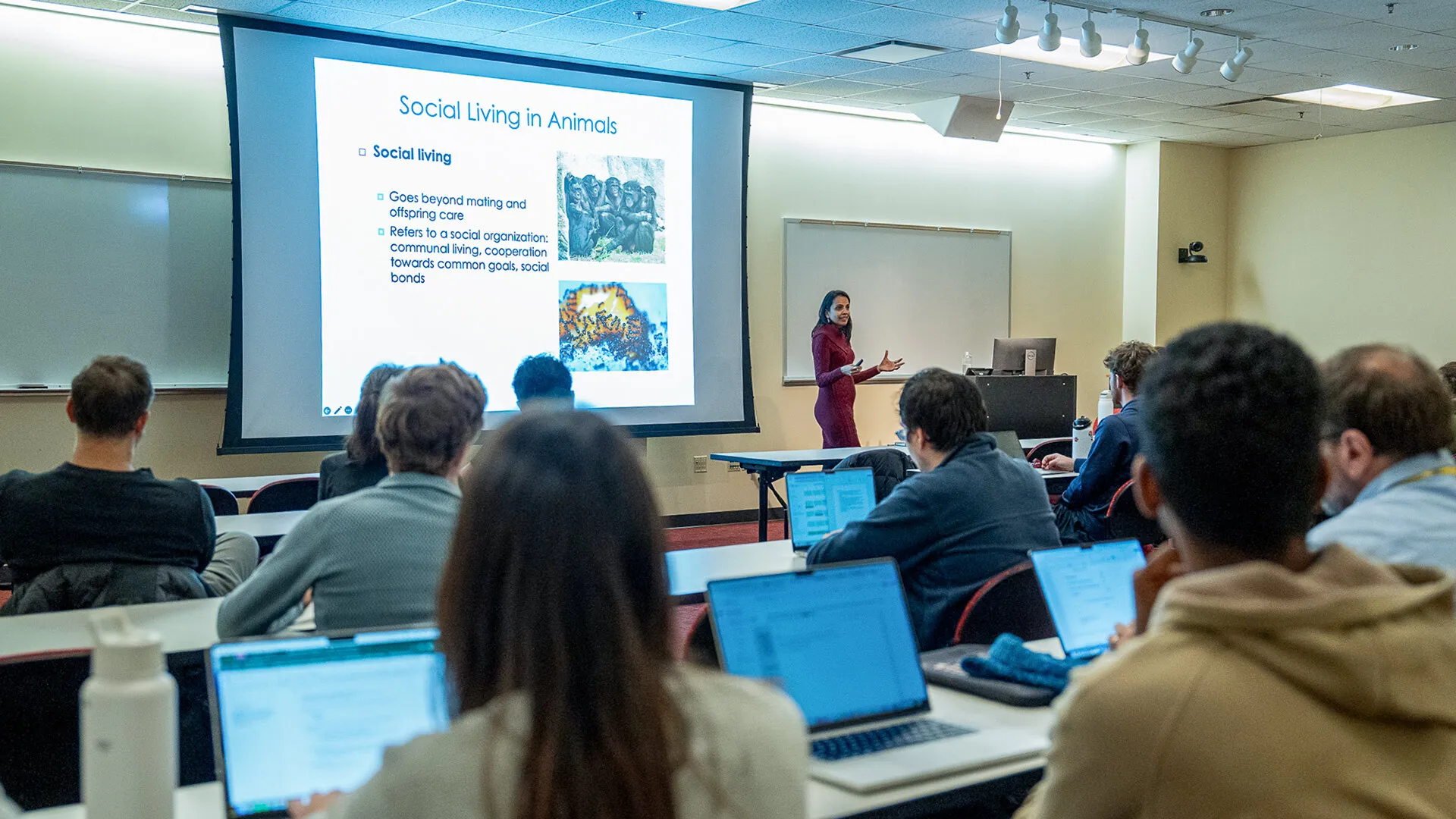
On a recent weekday, Levy showed a visitor around the center as dozens of mathematics researchers from around the world listened to a talk in a central auditorium as part of the weeklong “North American Descriptive Set Theory Meeting.” Later, he said, they might brainstorm together or grab coffee and break into smaller groups. Others could head to the offices the center provides to visiting scholars for solo calculations before reconvening.
“The main goal is to have more spectacular mathematicians from all over the world come to Maryland to give us the chance to work with them on research,” Levy said. “But also, people come here and find out what Maryland is all about and it raises our profile. Another effect is that our students, postdocs and faculty get frequent opportunities to interact with people of this caliber who probably wouldn’t be here without the center.”
Such conferences at the Brin Center put Maryland on the global map, said Ravi Vakil, president of the American Mathematical Society and professor of mathematics at Stanford University.
“You have a constant flow of the smartest mathematicians in the world going through College Park all the time,” he said.
Maryland’s math department already had an unusually broad base; it has long been respected in pure and applied mathematics research. The Brin family’s philanthropy activated that potential to create a math institute that’s both unusually comprehensive and, in the U.S. at least, uniquely free from constraints tied to government funding requirements.
“There was no ramp-up where you had five people slowly trying to build an institute from the ground up,” Vakil said. “It immediately became a place where there are a lot of possibilities, and anything happening is going to be a big deal.”
The 2024 gift also supported the establishment of two new Brin Professorships in Mathematics that brought internationally recognized researchers to UMD: Uri Bader, a leader in the area of mathematics that comes from the Furstenberg/Margulis school of ergodic theory and discrete subgroups of Lie groups; and Ron Peled, an expert in statistical physics and probability theory.
The Brins’ $2 million contribution to create the endowed positions was matched by the state Department of Commerce through the Maryland E-Nnovation Initiative, a program created to spur basic and applied research in scientific and technical fields at colleges and universities.
In addition, the Brin Maryland Mathematics Camp, first offered in summer 2024, gives students who’ve exhausted their high schools’ offerings a new challenge—and serves as a new recruitment tool. At least one student who participated in the camp is now enrolled at UMD as a math major, said Professor Larry Washington, associate chair for undergraduate studies.“We take some of the best math students from around the state—maybe the only ones in their schools ready for upper-level college math—and give them an experience they wouldn’t have in high school,” he said.
The Brins began making gifts to UMD in 2005, starting with an endowed chair in the Department of Mathematics, where Michael worked for 31 years.
“I am pleased to support the University of Maryland and to see the Brin Mathematics Center elevate the Department of Mathematics,” said Michael.
The Brins later endowed seven additional chairs and professorships in CMNS, including the Eugenia Brin Professorship that supports data assimilation research aimed at improving weather prediction and climate studies. Eugenia, a former NASA scientist, died in 2024.
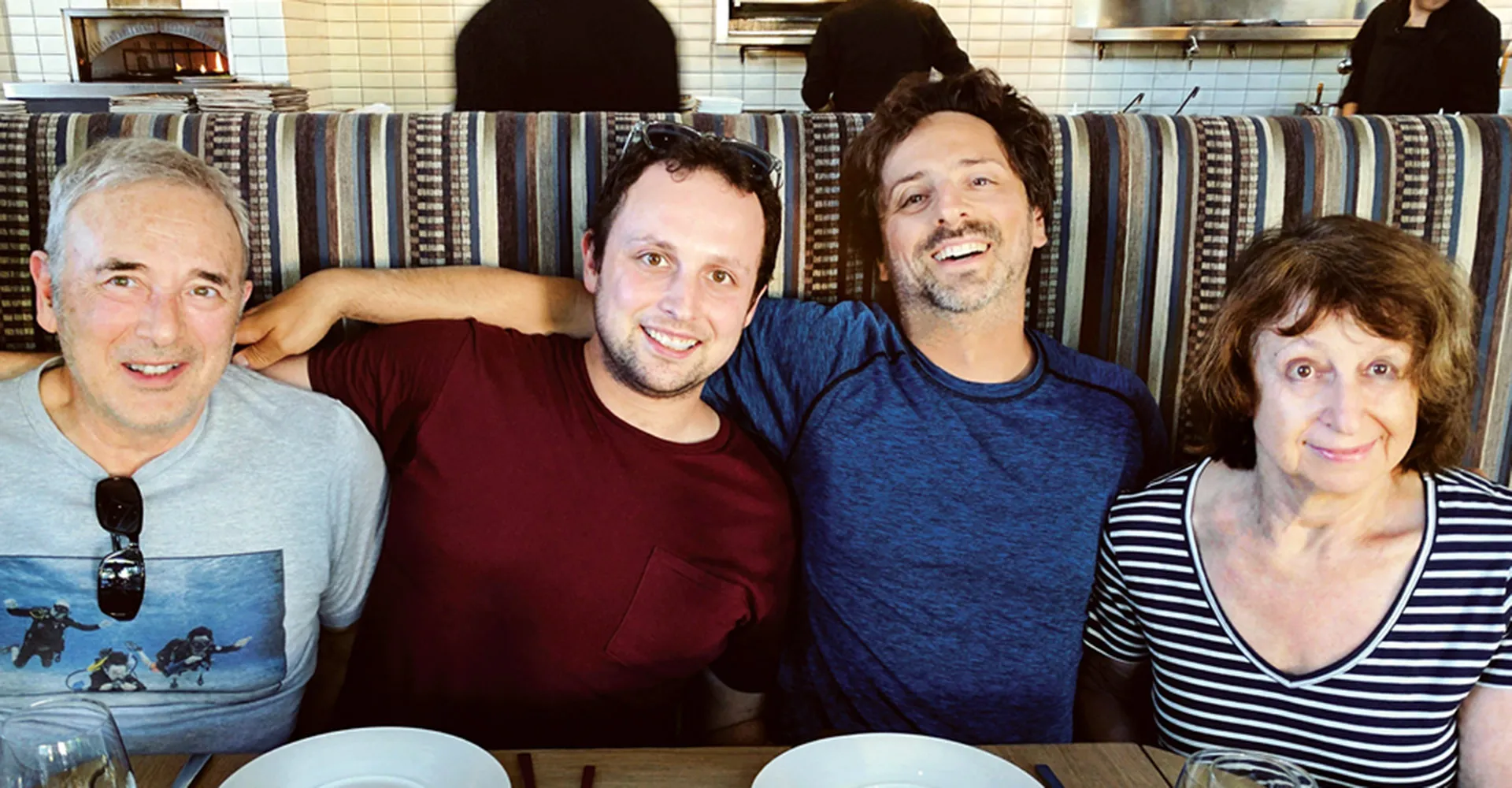
They also established the Michael Brin Prize in Dynamical Systems, the Brin Postdoctoral Fellowship program and the Michael Brin Graduate Student Endowed Fellowship program, all in mathematics. The couple’s younger son, Sam, a 2009 UMD graduate, led the Brin Family Foundation’s donation to establish the Brin Family Aerial Robotics Lab located in the Brendan Iribe Center for Computer Science and Engineering; it provides a flight testing area for drones.
In the College of Arts and Humanities, the couple established the Maya Brin Endowed Professorship in Dance and the Maya Brin Distinguished Lecturer in Russian in honor of Michael Brin’s mother, and created the Maya Brin Residency Program in the School of Languages, Literatures, and Cultures to bring leading cultural figures to campus for short-term stays.
In 2021, they gave $9 million to the university’s School of Theatre, Dance, and Performance Studies to create the Maya Brin Institute for New Performance, in honor of her love of the performing arts. It has added courses, expanded research and funded new teaching positions, undergraduate scholarships, classroom and studio renovations, and instructional technology.
Written by Chris Carroll. College of Computer, Mathematical, and Natural Sciences staff contributed to this article.

After a rewarding summer internship in 2025, mathematics major Arianna Maxwell will return to Roblox as a full-time employee in June.
By Jason P. Dinh
Arianna Maxwell was ecstatic when a recruiter from the online gaming and technology company Roblox called her late one evening last winter, offering her a summer internship in software development.
“I was so elated,” she said. “After talking to the recruiter, I called my dad and was like, ‘Oh my god, I can’t believe I got it.’”
Maxwell, a senior majoring in mathematics at the University of Maryland, always loved video games. She was raised in Santa Cruz, California, and relishes childhood memories of playing Mario Kart on the Nintendo Wii with her dad. She also played Roblox growing up.
“During my internship, I reminisced when I looked at current popular experiences because sometimes they were the same ones from when I was young,” she said.
Maxwell always wanted to work in the gaming industry. Games were her gateway to computer programming—she created Minecraft mods starting in middle school. But she didn’t major in computer science. Instead, she pursued her other passion: mathematics.
Maxwell first fell in love with math during high school. She was drawn to the definitive nature of proofs—how they could be arbiters of right and wrong. But she said it was the “cool and creative” nature of math that captivated her. After she realized that the field had broad applications and offered more than just memorizing formulas and rote work, “it was pretty hard to drop the interest,” she explained.
She explored math inside and outside the classroom at UMD. For example, through an undergraduate fellowship with UMD’s MathQuantum Research Training Group, she researched algorithms for partial differential equations on quantum computers. In her free time, she read computer science textbooks to teach herself how to code.
“It sounds embarrassing to say that I read textbooks for fun,” she said, laughing. But her hard work in self-teaching paid off once she started her internship at Roblox.
Over the summer, she worked on a feature called instance streaming, which loads objects into and out of the video game. Now, Maxwell will return to Roblox as a full-time software development engineer after she graduates in the spring. She’s looking forward to working on a broader range of engineering problems—and applying her math skills to her new work.
One obvious application is image rendering work, she said, which she has pursued through independent projects in her free time.
“So much of computer graphics is trying to use computer science and algorithms to render images and do a good job approximating life. A lot of that is just math, and then optimization to make it practical,” she explained. “There’s a lot of discrete math involved in computer science. The higher you go, I’ve noticed that the two fields blend more and more.”
Beyond subject matter expertise, her math studies fortified her discipline and strengthened her resolve by requiring her to focus on solving a single problem for four to five hours at a time. Plus, she developed a strong quantitative intuition and abstract reasoning skills.
“Math training really helps in being able to hold and manipulate many moving pieces in your mind,” she said. “The practice develops the abstract reasoning required to think through any complex system.”
Those skills are useful in any field of employment, she said—and, looking ahead toward a long career, she believes they’ll take her a long way.

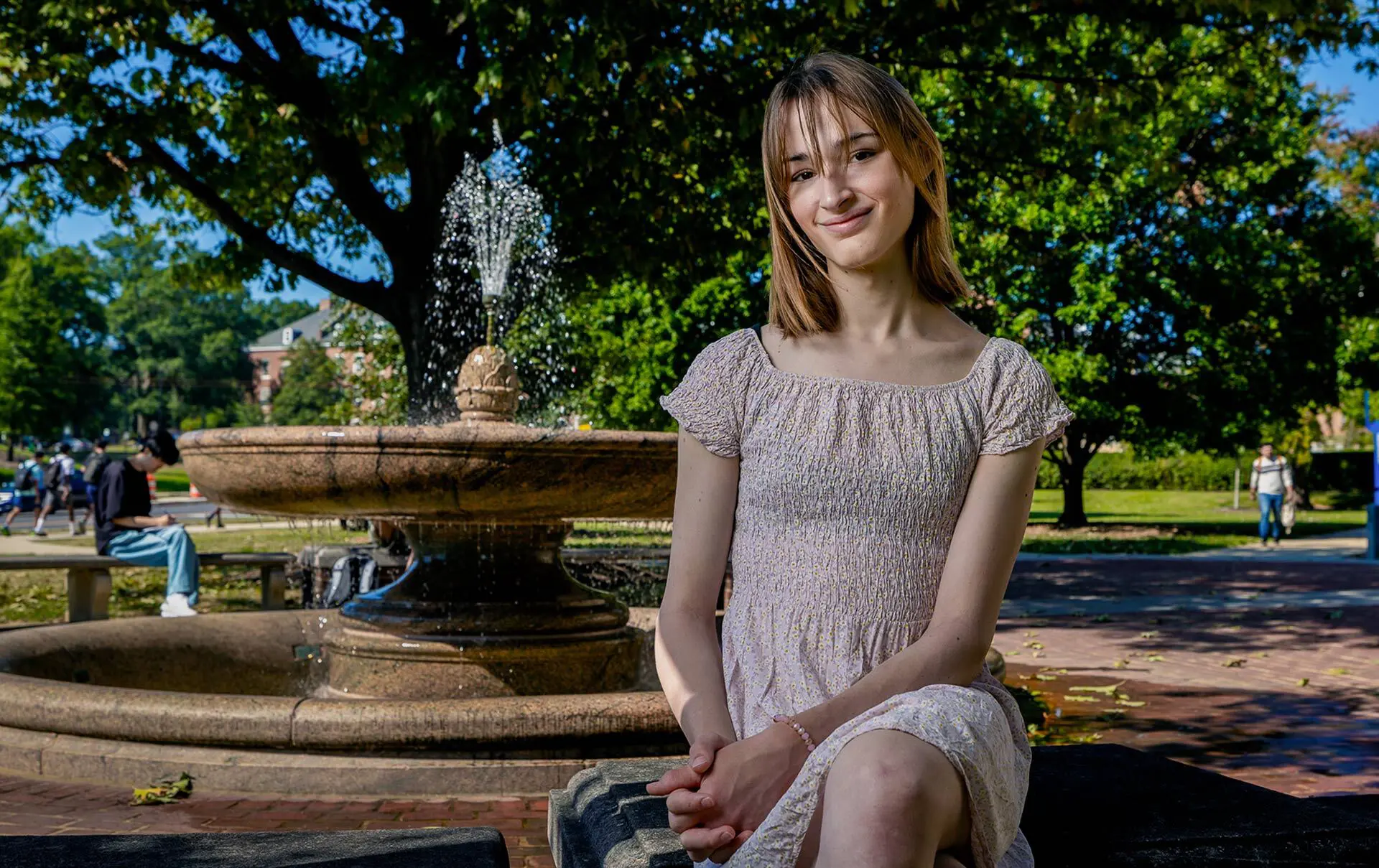
While many 17-year-olds last spring were preoccupied with planning for prom, studying for AP exams or booking houses for beach week, Hannah Cairo was shocking the not very teen-coded world of theoretical math.
In February, she disproved the Mizohata-Takeuchi conjecture, a math assumption that had stumped experts around the world for 40 years (and is impossible to summarize in lay terms). And she did it as a side project to her classes.
“Once I start working on a problem, it’s kind of addictive,” she said. “I can’t stop thinking about it. For every question I answer, I just have more questions.”
Now the remarkable teen will pursue those answers as she starts her doctoral studies at the University of Maryland this fall.
“She stands out head and shoulders above her peers,” said math Professor Wojciech Czaja, comparing her to prodigies like alums Charles Fefferman ’66, who won the Fields Medal, math’s highest honor, and George Dantzig ’36, who famously solved two open problems in statistical theory after mistaking them for homework. Cairo didn’t just tackle “a niche question that a small group of people were interested in. This is a well-known problem, spanning various areas of math.”
Growing up in the Bahamas, Cairo was homeschooled. Her affinity for math became apparent early as she raced through the Khan Academy’s online curriculum, learning calculus by 11. She pored over math textbooks on topics like analytic number theory under the guidance of tutors, finding beauty in the numbers and ideas. It was sometimes a lonely experience, but she found like-minded people when she joined her first math circle, extracurricular gatherings of mathematicians and students.
“They bring math puzzles and everybody collaborates, and it’s a really nice way to make friends,” she said.
That led her to apply at age 14 to the Berkeley Math Circle online summer program, where she found both challenge and camaraderie. A few years later, her family moved to California, and she joined Berkeley’s concurrent enrollment program to take graduate-level math courses.
One of those was on Fourier restriction theory, a branch of harmonic analysis, an area that has wide-ranging applications from telecommunications to music analysis and even image processing.
A few months in, Professor Ruixiang Zhang assigned a simplified version of the Mizohata-Takeuchi conjecture in homework. Cairo quickly completed the assignment—but couldn’t stop thinking about the problem. She spent months on proofs, consulting Zhang along the way, before coming up with her construction to disprove the conjecture.
She posted it to arXiv.org in February, and within a few months, she gave a talk at a prestigious math conference in Spain. Since then, she has gotten media coverage in Scientific American, Quanta Magazine and international new outlets.
It could be overwhelming, but Cairo, despite being soft-spoken, is eager to share her work.
In person, “it’s funny when people try to guess my age,” said Cairo, now 18. With her quiet poise, she’s often mistaken for a postdoc or a grad student when she’s among fellow mathematicians—but when she volunteered at a summer program, was mistaken for a camper. “I don’t hide my age, but I don’t want to brag about it.”
Maryland was eager to recruit Cairo, led by math graduate program director Leonid Koralov. Now, he and Czaja are eager to help her maximize her potential at UMD. She’ll continue to research Fourier restriction theory, but they also hope she can examine “other questions of importance to modern science,” said Czaja.
Cairo also hopes to explore additional opportunities on and off campus. As a trans woman, she hopes to increase visibility for LGBTQ+ students, and she’s also joined an animal rights student group. Once she’s passed her qualifying exams and settled in, she hopes to start a math circle for K-12 students in the local community, using games like Nim and Set to pique their interest.
“Mathematics to me is like an art, but in school they don't really teach it that way,” she said. “If you’re just memorizing steps, you’re not learning how to build things with ideas, paint pictures with ideas. I want to try to help people do that.”
Written by Karen Shih

AMSC Ph.D. candidate Mengting Chao’s step-by-step teaching method and commitment to student success earned her recognition from both students and faculty.
 When Mengting Chao started her Ph.D. in applied mathematics & statistics, and scientific computation (AMSC) at the University of Maryland in 2020, she never imagined she would win three major campus-level teaching awards in the next five years—or that teaching would become so central to her academic identity.
“It was the first year of the pandemic, and I felt a lot of anxiety about my future and what it would look like,” Chao recalled. “I felt very disconnected from my instructors and my peers, and there was a great deal of uncertainty at the time. I wasn’t sure how things would work out.”
Since that rough beginning, Chao accomplished more than she ever expected. In her second year, Chao received a serendipitous email from Bruce Golden, a professor of management science at the Robert H. Smith School of Business and an AMSC faculty member. Golden was recruiting new students for his research, and Chao quickly connected with him over their shared interest in operations research and joined his team.
Today, Chao is in the final stretch of her Ph.D. program, completing a dissertation on last-mile delivery logistics—the last leg and most crucial step in the shipping process, which involves moving a package from a local hub (like a distribution center) directly to the customer's doorstep. Chao says her work at UMD helped her find her niche in mathematics, and one of her research projects earned the 2025 Best Student Paper Award from the Decision Sciences Institute. Her research experience also led to internships with Amazon and RouteSmart Technologies (now part of FedEx), where she worked on optimizing logistics and transportation processes.
“Being able to come to UMD physically helped me feel more connected with the community here and have a better idea of what I wanted to do,” Chao said. “I also realized that I could do more with my math skills than I originally thought.”
While Chao conducted research with Golden’s group, she also began teaching courses like MATH 141: Calculus II and STAT 400: Applied Probability and Statistics. There, she discovered a deep passion for education and especially for helping students succeed.
“The first semester teaching was difficult, especially as English is my second language, but I really enjoyed it and actually received many positive teaching evaluations from my students. I also took their valuable feedback to heart and adjusted my teaching style accordingly,” Chao explained. “The experience made me think, ‘Oh, maybe I’m good at this!’ and I developed confidence in teaching, so I continued to do it.”
Chao’s students agreed. At the 2025 College of Computer, Mathematical, and Natural Sciences (CMNS) employee awards ceremony, Chao received the collegewide Dean’s Outstanding Teaching Assistant Award. More than 60 undergraduates nominated Chao, sharing stories about how Chao’s patience and step-by-step approaches to complex concepts made math easier for them. Chao also received the Department of Mathematics’ 2022 Aziz/Osborn Gold Medal in Teaching Excellence and UMD’s Outstanding Graduate Assistant Award, which placed her among the top 2% of more than 4,000 graduate assistants across campus.
“Being recognized for my efforts by this community helped me realize how meaningful I find interacting with and supporting others through teaching and mentorship,” Chao said. “I never would have imagined this for myself before.”
A foundation in patience and perspective
 Chao’s talent for teaching mathematics didn’t emerge overnight. Beginning in her sophomore year at Dickinson College in Pennsylvania, she worked as a tutor at the university’s Quantitative Reasoning Center. There, she guided students at various levels in mathematics, computer science and economics—three fields in which she eventually received bachelor’s degrees.
But Chao believes that her personal affinity for teaching and math goes back even farther than that.
“Growing up, I was always comfortable with numbers and enjoyed working with math,” she said. “I took Math Olympiad training classes for younger children while I attended primary school. And then, one day, I simply could not figure out a way to solve the problems—they’re not as simple as ‘one plus one equals two’ types of questions.”
With guidance from her grandfather, an accountant, Chao learned creative approaches that helped her solve problems in mathematics, and her interest in math blossomed.
“My grandfather really introduced me to the beauty of mathematics. In addition to helping me develop the skills to solve math problems, he also gave me the chance to see a problem from a different perspective,” she said. “When I saw how a problem could be solved in different ways, it really shaped how I saw math and how other people can approach it. Without that experience, I probably would have lost interest in math entirely and my path would look very different.”
Those childhood memories laid the foundation for the teaching principles Chao uses today and the approaches that help her connect with students in the classroom.
“I try to be completely transparent with content, creating detailed lecture notes, and uploading materials immediately. Everything is easily accessible and written out step-by-step so students can follow my thought processes,” Chao said.
Chao also tries to tailor her teaching approach to her students’ experiences and backgrounds. She often provides quick recaps to make sure everyone in the classroom is on the same page and draws on her interdisciplinary background to help students connect with the content.
“Keeping students engaged is a challenge, but a very important thing to keep in mind. If students feel discouraged, just like I was as a kid getting stuck, they sometimes just lose all confidence and don’t have any motivation to learn anymore,” she said. “I review things that they might have forgotten, even when more advanced students say it’s not needed, and try to provide real-world examples of more abstract concepts.”
For Chao, having great teachers was life-changing, and she hopes to make the same kind of difference for her own students, helping them achieve their future goals.
“My goal is to give students all the tools they need to succeed,” she said. “My philosophy is to always provide patience and perspective to students. They can feel it when you lack these things, and it can really make a difference.”
Written by Georgia Jiang

Studies show darker-skinned patients suffer greater mortality from skin cancer. A tumor detection model built by a team that includes mathematics and computer science double-degree student Dhruv Dewan could help close the gap.
For a student so interested in technology, Dhruv Dewan finds a surprising level of comfort in being unplugged. When he’s not exploring the inner workings of artificial intelligence (AI) models, he loves hiking through the woods.
The University of Maryland double-degree senior in mathematics and computer science is an Eagle Scout and avid backpacker—his favorite trek is a weeklong, 50-mile route in Virginia on the High Knoll Trail in the Blue Ridge Mountains.
Dewan sees a common thread that unites his two passions. Both foster a mindset of exploration and require transferable skills in problem-solving and resourcefulness—whether it’s to solve a mathematical proof or devise a way to keep food safe from bears.
Now, Dewan brings that skill set to his studies at UMD. For his four-year research project in the Gemstone program in the Honors College, Dewan and his teammates on “Team Artificial Intelligence Diagnosis” (AID) are developing AI models that can more equitably and accurately detect skin cancer through photos. The three-person team consists of Dewan, a computer science major and a bioengineering major working under the supervision of Heng Huang, Brendan Iribe Endowed Professorship in Computer Science.
Dewan hopes that doctors can use these models to better diagnose skin cancer in people with darker skin, who have statistically lower survival rates than white patients.
“I've really seen how exponentially helpful having a deep understanding of math and statistics is for understanding how machine learning and AI work,” Dewan said. “These models just multiply matrices by other matrices. At the end of the day, it’s all truly, purely math.”
Improving AI for Cancer Detection
Many models can detect skin cancer from images, Dewan said, but they are mostly trained on people with lighter skin tones.
“That introduces a really big issue in how equitable they are,” he said. “Many models are good at diagnosing skin cancer for whiter and lighter-skinned patients. But when we tested them on a diverse dataset of skin types that included various darker skin tones, we found that they performed extremely poorly.”
Thus, one approach his team takes is to incorporate more diverse data into training sets and ensure that the models pay attention to those data points.
Additionally, the Gemstone team integrates self-supervised learning into the training process. Existing methods train models on photos labeled as cancerous or non-cancerous. By contrast, self-supervised learning provides the model with a larger sample of unlabeled data. Their model learns deeper features of the images using that expansive dataset, which it can later use to identify telltale signs of cancer. This could prevent the model from overfitting on skin tone as its primary diagnostic criterion.
Dewan finds that his background in mathematics benefits his AI and machine learning research.
“Many of the techniques that we’re using to improve current methods are pure statistics,” he said. “Having an intuition for statistics and math allows me to understand how the model works and diagnose how to improve it.”
Dewan expects that the final model, which his team will present at the end of the Spring 2026 semester, will be able to generalize skin cancer beyond only the skin tones it has seen during training.
"We hope this model helps to provide early diagnosis for darker-skinned patients who have a much lower survival rate for skin cancer because they’re diagnosed too late or because doctors can't diagnose them,” he said. “Hopefully, doctors can use this model as a tool. It feels really fulfilling that this could have an impact.”
Wherever Dewan ends up, he wants to work on robust and scalable software while keeping equity in mind. And, he hopes to quench the thirst for exploration that he developed as an Eagle Scout.
“Whether I am in academia or in industry,” he said, “I hope to carry that research and exploration mindset going forward.”
Written by Jason P. Dinh
College Park, MD 20742-4015
P: 301.405.5047 | F: 301.314.0827